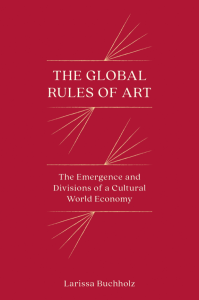

Book Website at Princeton University Press
Reviewer Copies at Princeton University Press
Prior to the 1980s, the postwar canon of “international” contemporary art was made up almost exclusively of artists from North America and Western Europe, while cultural agents from other parts of the world often found themselves on the margins. The Global Rules of Art examines to what extent this situation has changed in recent decades. Drawing from abundant sources—including information regarding the cultural infrastructures of over a hundred countries, multiple institutional histories and discourses, extensive fieldwork, and interviews with artists, critics, curators, gallerists, collectors, or auction house agents—Larissa Buchholz analyzes how a world-spanning art field has emerged and how its hierarchies and logics are produced, contested, and structured in global terms.
Deftly blending comprehensive historical analyses with illuminating case studies, The Global Rules of Art advances a new understanding of valuation by showing how recognition, inclusion, and exclusion are patterned across unequal global conditions and how cultural hierarchies take shape in a global context. The book’s innovative global field approach offers a systematic account of how cultural power operates on a world scale and will appeal to scholars in the sociology of art, art market studies, art history, interdisciplinary global studies, and anyone interested in the dynamics of global art and culture.
- Winner of the International Book Award for Art
For a summary of the book’s arguments regarding the interdisciplinary globalization and art debate, see the recent article “What is “Global” about Contemporary Art? Some Clarifications on the Global Field Perspective and “Distant Seeing.” Nonsite (Peer-reviewed quarterly journal of scholarship in the arts and humanities). # Issue 48 (December)
Book Reviews and Endorsements:
“Based on fantastic fieldwork, numerous interviews & exceptional historical scholarship, The Global Rules of Art by Larissa Buchholz is the most powerful and compelling research about the new dynamics of global art today.” Annie-Cohen Solal, Distinguished Professor at Bocconi University in Milan
“Buchholz provides a novel explanation of how the international contemporary art world expanded and diversified from the 1980s to today. The Global Rules of Art is a stunning scholarly achievement.” Fiona Greenland, author of Ruling Culture: Art Police, Tomb Robbers, and the Rise of Cultural Power in Italy
“At once lucid, rigorous, sweeping, and innovative, The Global Rules of Art is a true tour de force, a must-read for cultural sociologists, art historians, social theorists, and scholars of globalization. A stunning achievement that sets a new standard for sociological analysis.” Philip Gorski, Yale University
“A remarkable examination of the globalization of the art world over the past forty years and the new questions and forces with which it is confronted today. Adapting what Pierre Bourdieu called the ‘rules of art’ to the new geographies and internal tensions in this expanded field, this magisterial analysis exemplifies the vital role that a systemic sociology of culture can play for us today.” John A. Rajchman, Columbia University
“Impressive and important. The Global Rules of Art is exquisitely written and theoretically and empirically exceptional.” Clayton Childress, author of Under the Cover: The Creation, Production, and Reception of a Novel
“. . . a brilliant study of the international art field, moving Bourdieu’s analysis of culture onto a vastly expanded geographic scale. Top of the list for new social science books in 2022!” George Steinmetz, Michigan University
“Mobilisant une démarche tout à la fois historique, sociologique et comparative, Larissa Buchholz examine comment un sous-champ mondial de l’art contemporain a émergé au début des années 1980 et comment, en pratique, s’y jouent les carrières des artistes non occidentaux.”
“An ambitious theoretical proposal that represents a significant advance in the sociology of art and globalization.” Gloria Guirao Soro, Revista Española de Sociología (2025)
“Buchholz’s book stands not only as a cornerstone of a new sociology of art – one that extends Bourdieu’s materialist framework to a global scale – but also as a potential bridge between academic sociology and the professional art world. It deserves to be essential reading for art professionals, encouraging them to reconsider the sociology of art not as a disowned stepchild, but as a vital tool for understanding their own field.” Kristóf Nagy, MIEJSCE (2024)